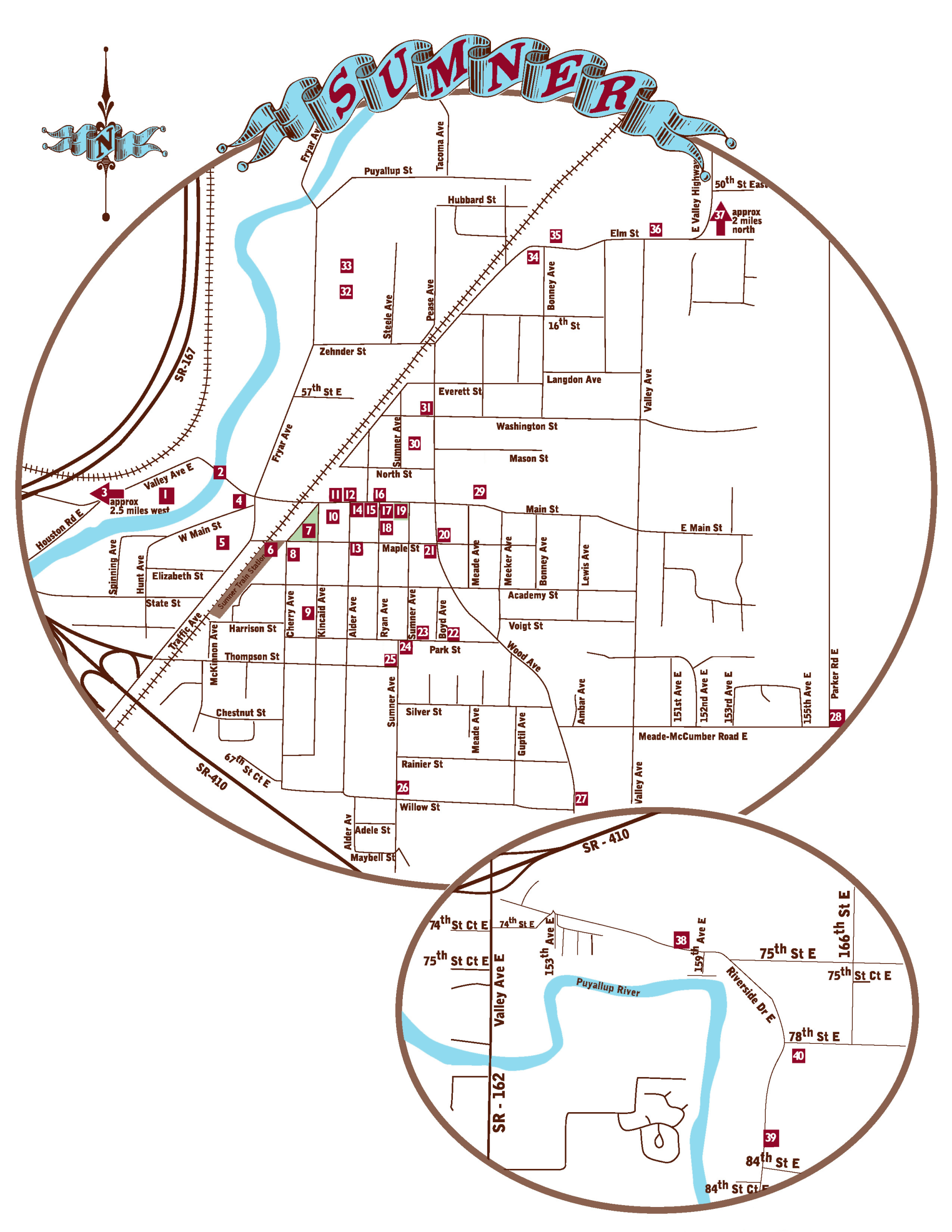
Indigenous Residents & Early Settlers
This area was first home to the many Lushootseed speaking peoples of the northwest, who lived in villages from the foothills of the mountains along the rivers, creeks, and prairies to the shores and islands of the Puget Sound.
The first European settlers arrived in this area in 1853 with members of a wagon train crossing over the mountains through the Naches Pass. Isaac Lemon and Addison Perham signed for donation land claims on September 20, 1853, followed by Charles Bitting, George D. Heyward, Abial Morrison, William Kincaid, Robert S. More, Johnathan W. McCarty, Thomas Owens and Abram Woolery.
On December 24, 1854, the Puyallup people, along with neighboring tribes and bands, were invited by representatives of the US Government to participate in a potlatch at šxʷnanəm (Shwh-nah-num), or Medicine Creek, also known today as McAllister Creek, near what is now the Billy Frank Jr. Nisqually National Wildlife Refuge. After three days of poorly communicated negotiations, a few of the tribal representatives, not speaking or writing English, signed their X’s on the Medicine Creek Treaty, although many believe those X’s were forced, if not forged.
With this, three reservations were created: Puyallup, Nisqually, and Squaxin Island. Not only were the original reservations too small, but they were also poorly located, away from the resources that sustained their people. As a result, the Treaty Wars, commonly referred to as the Indian Wars, took place between 1855-1856. During these wars, many battles took place in the region. Settlers’ cabins in the Sumner area burned as families stayed at Fort Steilacoom. While each tribe had their own experiences, their motivations for fighting were all the same: a feeling of being pushed out, abused, and even murdered by new settlers.
In late August of 1856, through representative Isaac Stevens, the U.S. Government renegotiated the treaty at what became known as the Fox Island Council. These renegotiations, led by Puyallup Chief Squatahan, expanded/relocated the Puyallup, Nisqually, and Squaxin Island reservations and formed the Muckleshoot Reservation. Muckleshoot Indian Tribe’s membership is composed of descendants of the Duwamish and Upper Puyallup people who inhabited Central Puget Sound. The Tribe’s name is derived from the native name for the prairie on which the Muckleshoot Reservation was established, northeast of what is now Sumner.
The Puyallup Tribe of Indians and the Muckleshoot Indian Tribe remain active partners with the Sumner area. The Puyallup Tribe has become a recognizable force in the fight for tribal rights, notably tribal fishing rights eventually leading to the Boldt Decision in 1974. The Puyallup Tribe also became a political force, particularly since the 1990 Land Claims Settlement between the Tribe, local governments, Washington State, and the US Government.
Learn more: explore the cultural resources and events available to the public by both the Puyallup Indian Tribe and the Muckleshoot Tribe of Indians. The City’s current work with the White River Restoration Projects also furthers long-languishing promises made in treaties.
William Kincaid Family
Originally from Missouri, William led the wagon train over Naches Pass into the area that would become Sumner in 1853. Settlers used his property corners to stake their claims, which is how he earned the distinction of founding Sumner. In addition, his daughter Laura served as the town’s first schoolteacher, and his son John incorporated the town. Kincaid sold his cabin to George Ryan.
George & Lucy Ryan
In 1873, George Ryan came west from Baraboo, Wisconsin and purchased 40 acres in Sumner from Main Street to Park Street from Laura Kincaid Seaman. He married his childhood sweetheart, Lucy V. Wood, in 1875 in San Francisco. Together, they farmed 40 acres, raising fruit, vegetables and hops. The Ryans also owned a sawmill; platted a town on the original 160-acre Kincaid Donation Land Claim; built a big section of the business district and helped establish a railroad depot. George Ryan was elected Sumner’s first mayor in 1891, and Lucy ran the post office for a time as well as the farm. Like others in the valley, the Ryan household employed members of local Tribes as well as Chinese immigrants, including Chan, their Chinese American cook. Lucy Ryan wrote that her son was so enthusiastic about Chinese traditions that “I am expecting him to throw away his spoon and eat with chopsticks.”
Clara McCarty Wilt
Granddaughter of William Kincaid and daughter of pioneers Jonathan McCarty and Ruth Kincaid, Clara McCarty was born in 1858 at Fort Steilacoom and grew up on a farm across the Stuck River (now the White River) from Sumner, roughly near Cannery Way today. When she was 12, the family moved to Seattle. In June 1876, Clara was the only member of the first graduating class of what would become the University of Washington. She was elected superintendent of schools in Pierce County in 1879, the first woman to hold that position, and bought the first typewriter in Pierce County.
John Vokich
An Eastern European immigrant who came to America in 1905, Vokich began work repairing tracks for the Northern Pacific Railway. After being injured in an accident, he moved to Sumner in 1929, where he worked as a crossing watchman at the Main Street crossing before it was automated in 1947. His 4’ x 5’ shack stood on the west side of the tracks, north of Main until 1946 when it moved to the opposite corner. School kids remembered greeting Vokich every day. He was known for sharing his food with “hoboes” riding the rails and decorated a fir tree next to the shack with daffodils for the festival. According to his daughter Irene’s memories, his proudest moment was in September 1932 when President Franklin D. Roosevelt traveled through Sumner on his way to the fairgrounds in Puyallup. (Source: “Main Street Crossing Guarge” by Irene Vokich Thompson in Down the Track by Ruth Trueblood Eckes)
Ah “Joe” Young
Ah “Joe” Young was born in China in 1866 and sold to the railroad by his father. In the late 1880s, he worked on the Northern Pacific lines including, it seems, the pit in Sumner that supplied the gravel for the grade between Sumner and Dieringer (now the Burlington Northern Santa Fe tracks). Afterwards, he went to work for Frank Young’s family on their farm near the Sumner Cemetery. Sadly, Sumner experienced the riots and raids that plagued this region in the late 1800s along with the Chinese Exclusion Act. The Young family cut Joe’s hair and helped hide him from the raiders. After the raids in 1894, Frank Young moved to Spokane, and Joe went with the family. Later, he chose to return to Sumner and started his own berry farm and garden, being one of the first to grow celery. After a failed attempt to marry through a Lonely Hearts ad, he married “Mrs. Debau, of Oregon” and they adopted a daughter. The family lived on Elizabeth Street for many years. When he died in 1916, Young’s service was held at the old Sumner Methodist Church (#31) and attended by many city leaders.
Dr. John Kanda & Family
Dr. John Kanda, his wife Grace and daughters Phyllis and Jean, were active members of Sumner Methodist Church (#20). Dr. Kanda built his practice in Sumner after World War II, bravely redefining the role of Japanese-Americans in American cities after their incarceration. He started his practice by vaccinating children at the Sumner schools, serving “temporary residents” in our City’s jail and working the emergency room at Good Samaritan Hospital. His family practice grew through his retirement in 1987. Before moving to Sumner, Dr. Kanda served out of the internment camp in the 100th/442nd Regimental Combat Team in Southern France and Northern Italy as a rifleman 1st scout through World War II. After earning his medical degree, he chose Sumner to practice, also serving as president of Sumner Rotary Club, the Pierce County Medication Society and the Puyallup Valley Japanese American Citizen’s League (JACL). He also served as the National Vice-President for JACL and co-chaired the local effort to repeal the Alien Land Bill of 1921, literally going door-to-door to talk with people about why this was so important. [More about the Alien Land Bill from HistoryLink.org]
Reuben Knoblauch
Reuben Knoblauch was born in 1914, about the same time his father Henry was starting the hot-house rhubarb industry. Reuben went on to serve in World War II before running for State Senate in 1947, a position he would hold for 30 years. During that time, he was instrumental in developing the Seattle World’s Fair in 1962. Intent on returning this site to a downtown park (#7), he willed funds for the park in 1992.
Ota Family
Before manufacturing brought the warehouses to 142nd Avenue, the valley was home to many farmers of varying heritages, including Japanese Americans. A photo shows Matahichi and Kisa Iseri at their farm stand in 1908. They leased a farm in Sumner and grew raspberries for various canneries, using handmade wooden berry cups. The Ota family ran their farm in the 4200 block of 142nd Avenue. Like all the Japanese farmers, they were forced to leave during the World War II internment, or incarceration. After the war, many could not or did not want to return. The Otas did come back to Sumner, remaining active farmers, especially rhubarb and hothouse rhubarb, through the 20th century. Their family shared many pieces of their farming history including photos from the mid-1900s.
Jane Cole
Jane Cole was born in England and originally worked as a seamstress for the Royal family. She came to America with her brother Edward, and they rented the Abraham Woolery farm in Sumner, which extended from Meade-McCumber to the Puyallup River. She worked in the linen room of the old Tacoma Hotel and also took over managing hens and cows, letting Edward work the hops. She began to sell eggs and butter with Susannah Thompson, her first customer. Thompson connected Cole to families in Tacoma and every Saturday, Jane would drive her pony Billie the nine miles to and from Tacoma to deliver butter and eggs. Later in life, after Edward’s death, Jane built a house on Academy next to the Presbyterian Church and later on Alder Avenue, where she passed away.
Learn More
These are just a few of the people who have made Sumner what it is. We will keep adding stories over time. Please also visit the Sumner Historical Society, Meeker Mansion, Washington State Fair Museum, White River History Museum, the Northwest African American Museum, MOHAI and Washington State History Museum for more about the people of our area.
For more information about the history and legacy of the Chinese Exclusion Act, please also visit the Chinese Reconciliation Park in Tacoma. To further explore the internment and incarceration of Sumner’s Japanese citizens during World War II, please visit Densho and JACL’s exhibition about the ironically named Camp Harmony at the Washington State Fair. While we must remember the horrible events of the past, we also do not want current cultures defined only by those. Please also explore the Asia Pacific Cultural Center to learn more about the vibrant Asian cultures who have been part of Sumner throughout history.
Privacy: Many of the sites and structures are privately owned. Please respect the rights and privacy of the owners and occupants of private residences and businesses.
1. Cannery Warehouses
13608-A Cannery Way (Business)
This large warehouse was originally the H.A. Baker Cannery and changed hands in 1921 for $115,000. It served as the Sumner Plant for Washington Packers, Inc. and changed hands a number of times. Farmers would drop off loads of produce in front of the Cannery for processing. When produce arrived, the cannery would sound a horn and women in Sumner would put on their white uniforms to come help can the produce. Inside the building, you can see nails shot into the floor to unclog the nail-guns as they made crates. Even soldiers from Ft. Lewis would come work when off-duty would earn a few extra dollars. Clyde Farquhar became a manager of Washington Packers and moved into marketing in the 1920s. In the late 1930s, Kelley, Farquhar and Company sold frozen foods throughout the world. The buildings have been a furniture store since 1984. Walk through during open hours to find more pieces of Sumner history hanging on the walls and from rafters, including the old Red Apple Market sign and the stop light that served at Wood & Main for decades.
2. Cannery Way Bridge (Public)
This current bridge, built primarily in 2019, is the fifth span in this area. The first was completed in 1863 at a cost of $495. The fourth bridge, a steel-span truss bridge, was built in 1927. You can visit a portion of it in the park on the west side of the current bridge. Its distinctive concrete and metal handrails were also replicated on the current bridge. The steel-span truss bridge started to gain fame at the holidays when it was covered in lights. For that reason, the current bridge also features lights, although with a modern catenary design and LED lights that can change colors for seasons and occasions. The current bridge also features pedestal lanterns with a hops design. Their lattice pattern replicates the design of the structures to grow hops to echo past agricultural crops of the valley.
3. Sumner Cemetery
12324 Valley Ave E, Puyallup, WA 98372 (Public)
Note: While this is a public space, please also remember that it is an active cemetery and a place of mourning and remembrance for many.
In 1864 the Pioneer Cemetery began on two acres of land donated by Isaac Woolery. In 1902 the “town” section of the cemetery was added. Bill Woolery, the son of Isaac Woolery, acted as sexton for the pioneer part until the two sections were united and the City of Sumner took over its management. Take some time to visit the Cemetery and many of the people included in this tour. On Memorial Day, flags are placed at the markers of veterans, who have served in all wars and conflicts of American history since the Civil War. Of particular note, stop by the Heritage Farm where Frank Shigio’s bright red tractor now has a place of pride. Tom Shigio was president of the Washington Rhubarb Growers Association when the two previously separate grower associations merged in 1974. If you proceed south toward the new Rainier View Green Burial section, you’ll notice two wrought-iron gates. These were the cemetery’s original gates that sat for years at the, then, one entrance off Valley Avenue.
4. Old Sumner Collision
725 Main Street (Business)
Oz Rogers “began greeting drivers of Chevrolets” in 1927 on Main Street and North Ryan, as reported in the Sumner News-Index. “Later, with the removal of the agency, Mr. Rogers continued the Sunset Garage at that location for a while and then moved to the garage at the end of the Stuck River bridge.” Oz Roger’s Sunset Garage resided at Traffic & Main until Rogers moved out in 1940 and the building became Riverside Garage. Although the business changed hands and the building changed a bit, it’s still standing and visible at the end of the current Cannery Way bridge.
5. Sunset Chevrolet
910 Traffic Avenue (Business)
Once Rogers became an authorized Chevrolet dealer again, he needed more room for a showroom and shops. He bought the property of Richfield Chevrolet (one block south) of his garage and moved in 1940. The building was remodeled and by the 1950s, took the name from original garage to become Sunset Chevrolet. Rogers sold the business to Buster Van Horn. Although extensively remodeled around 2010, Sunset Chevrolet remains in this same building and location.
6. Train Station
810 Maple Street (Public)
Trains have always stopped here in Sumner. One block north, on the west side of the tracks was the site of old Burlington Northern Railroad Depot. In 1873 Northern Pacific announced that Tacoma would be the terminus of their rail line. Northern Pacific officials said they could not stop along the line until a depot was erected. George Ryan built a depot at his own expense and paid the salary of the agent for a year. He was reimbursed later, and Northern Pacific took over the station. The advent of the railroad did much to stimulate the town. After the railroad came through, the town was platted on the Kincaid Donation Land Claim. Industries such as food processing plants sought sites along the railroad. When fruit shipments would arrive at a cannery, the train whistle would call workers. Until 1962 the Sumner city limits could be reached within a fifteen-minute walk from the terminal. The original depot has since been removed and replaced with the Sound Transit commuter rail station. Opened in 2001, the new station incorporates public art designed by T. Ellen Sollod and based on the community’s history. The two metal trellis structures greet commuters entering the station. The roof of each pays homage to Sumner’s past with the pattern of hops vines that cast shadows on the sidewalk below. Accompanying tree grates of a stylized hop blossom design are used throughout the station. The Station’s buildings mimic the historic architecture of the old hops barns and chimneys of the drying kilns.
7. Reuben A. Knoblauch Heritage Park
Block of Main Street, Maple Street, Cherry Avenue & Kincaid Avenue (Public)
This site first housed the Hocking Brothers store until 1911 when J.J. bought out brother Roswell’s interest and changed the name to J.J. Hocking’s Department Store. Later, with the building gone, it became Hocking Square and housed the City’s bandstand before that moved to City (now Loyalty) Park, #24. In the later 1900s, it became Daffodil Square Texaco gas station, owned by Mick Kauth. Reuben Knoblauch willed funds for the park in 1992. The park was designed and constructed in 1995-96 with materials and labor donated by other local individuals, families, and businesses. The space returned to its roots with a bandstand to host Music Off Main concerts and other festivals. In 2021, the City purchased the last private parcel in the block and a redesign of the space will further increase its availability to host events and attract visits every day. All names from the 1995-96 version will return to the newly redesigned park to continue to honor our Heritage as amenities continue to improve.
8. Old Sumner Hotel
817 Cherry Avenue (Private)
The Old Sumner Hotel was located close to the original Sumner Railroad Depot. The two-story wood-frame cottage was built around 1890 and originally stood at the triangle facing old Narrow Street. The old hotel now contains several apartments.
9. Whitworth College
Block of Alder, Cherry, Academy & Park (Site, Private)
A lot was deeded as a site for the Presbyterian Church by John Kincaid, and the Church was erected in 1877. Once a month, Dr. George H. Whitworth rode from Seattle to preach. In 1883, Whitworth and four colleagues established Sumner Academy, at the Presbyterian Church. Its focus was on liberal arts. In 1890, the renamed Whitworth College moved to the block bounded by Alder on the east, Cherry on the west, Academy on the north and College (now Park) Street on the south. The institution enrolled both men and women. To reach a larger number of students, the College moved to Tacoma in 1899 and then to Spokane in 1913, where it is presently located. After the college left, the building became a hotel until it was destroyed by fire in 1918. The first edifice to be built on the grounds was St. Andrew’s Catholic Church. Although St. Andrews moved to a new building on Valley Avenue, the site continues to serve as a church.
10. Hops Alley
Alley between Alder and Kincaid Avenues (Public)
This is a new space, built in 2025; however, the artwork and name reference the hops crop that initially built many of the grandest homes on this tour and initially attracted many of the settlers to this area. However, a blight, caused by an aphid disease in the soil, obliterated the industry nearly overnight in 1892. A few wealthy growers lost everything including their homes while others quickly transitioned their land to grow daffodils, berries and rhubarb.
11. Phoenix (Masonic) Lodge (Business)
1005 Main Street
This two-story brick building with a flat roof and decorated crenellation was designed in 1924 by William Aitken and constructed by William A. Blackadder to house the Spencer & Fryar Grocery Store and offices. In 1952, the same architect designed a second story alteration to allow a lodge room and banquet room. The building has served multiple businesses, including the 5¢ and 10¢ Variety Store in the 1950s. It remains operated by the Sumner Masons with businesses in the ground floor. Blackadder also designed the Weaver Apartments (#21).
12. 1101 Main Street (Business)
In 1903 this building was constructed as a bank. The vault remains inside today. One of the few structures to survive early fires in Sumner’s history, the building has served many purposes. In 1913, Messick & Son housed a confectionery and ice-cream parlor here. By 1949, Waldo Corbin converted it into Corbin’s Fountain Lunch and many people remember Waldo and Juanita as key members of the community. They would decorate the windows for the Daffodil Parade and in the 1950s, the BPA, the Business & Professional Association of women who worked in Sumner met here. By the late 1900s/early 2000s, it was the popular Berryland Café, known for Lola Bursle’s rhubarb pie. A renovation in the early 2020s helped the building find new life for businesses on Main Street.
13. Sumner City Hall
1104 Maple Street (Public)
This two-story brick building houses the City administration offices and police department. The City purchased the property from Laura Ranney in 1928, the same year that Sumner’s status changed from a town to a city with a population of 1,426. The original building at the northwest corner was constructed in 1935, and the eastern addition was opened in 2001. If you stand on Alder Avenue and look at the three bays of windows on the ground floor, you can see the original three bays to house fire engines that were originally in what is now the City Council chambers. The City also found the original, custom built wood door that served as the front door. It is now a sliding door within a conference room on the first floor.
14. Former Bank Building
921 Alder Avenue (Business)
This corner originally housed the wood Shipley Building, which Sumner’s newspaper called “one of Sumner’s most pretentious business buildings….” It housed many businesses, including Bray & Baker’s Hardware, Darr & Kelley grocery, W.H. Ingalls shoe and harness shop, the Hotel Best and the office of Dr. J.H. Corliss. The entire building burned to the ground in August 1914. It was replaced by Standard Oil’s gas station with distinctive mission-style arches. By the mid-1900s, the current building was constructed as two businesses: Beren’s Drug Store faced Main with the distinctive curved corner wall still visible while a bank occupied the back half of the building with a door facing Alder Avenue. Over time, the bank took over the entire building and expanded to add drive-through lanes facing Main Street. The lanes occupy the site of the Liberty, later Riviera, Theater. In 1924 D. Constanti opened the theater, a similar style to the one still standing in downtown Puyallup. In 1936, Mike Barovic took over ownership as a group of five theaters. The theater was lost to the drive-through lanes after 1970.
15. Sumner Grocery Co.
1114 Main Street (Business)
This building served as many businesses, including Sumner Grocery Co. a Piggly-Wiggly store and Tony Strozyk’s Valley Variety. Strozyk often used his children in promotions with his family living above the store. Valley Variety would later move across the street to 1201 Main. This building underwent a major renovation in the early 2000s to become a restaurant on the ground floor and residential again on the upper floor.
16. Puget Power building
1207 Main Street (Business)
This structure was originally built for Puget Power in the 1930s. It is a one-story cement-block utilitarian building with a flat roof and raised cornice. The center recessed entry has side quasi-Art Deco pilasters with a stepped gable peak and circle design. Above the door are three true arched recessed windows. If you look closely around the awning, you’ll still see electric bolts, signifying this building’s original use as a power company.
17. Sumner-Tacoma Stage Company
1202 Main Street (Business)
By the 1920s, the Sumner-Tacoma Stage Company’s depot was on Main Street near Ryan Avenue. Brothers Peter “P.O.” Conlon and John W. Conlon bought the line in 1921. In 1922 they also bought the Puyallup and Orting bus lines. Smaller busses served Wilkeson and Carbonado near Mount Rainier. By the 1930s the Sumner Tacoma Stage Company had been renamed the “Blue Lines”. The company was owned by Peter Conlon. In 1925, the Conlon Brothers were also selling Maxwell and Chrysler cars in Sumner. Conlon sold the bus business in 1939.
18. Ellen’s Charm Beauty Salon
919 Ryan Avenue (Site)
Owner Ellen Prukop operated her salon here until it was later located at 915 Alder Avenue and finally on Academy Street before being sold to Mary Gill in 1968. For National Beauty Salon Week in February, the Salon would do the hair of Sumner’s older ladies for free. Through the 1950s, working women met as the BPA, the Business & Professional Association, gathering routinely at Corbin’s Fountain Lunch (#12).
19. Lucy V. Ryan Park
1228 Main Street (Public)
This park is the site of the Ryan House, which was first built in the 1860s as the Kincaid/Seaman one-room cedar cabin. The property was sold to George Ryan in 1872 and enlarged in 1875. The Ryans added the main section of the house in 1885 with wood from their own sawmill. George Ryan was instrumental in establishing the town of Sumner and became its first mayor in 1891. The Ryan heirs donated the house and grounds to the City as a park in 1926 in honor of Lucy, who loved horticulture and ran many enterprises, including the postal service. Several of her memories are recorded in the book, The Sumner Story, by Amy Ryan. The house served as the library until the 1970s when it transitioned to a museum. In 2023, a planned rehabilitation found the house was in structural failure and was removed in 2025.
20. Sumner Methodist Church
901 Wood Avenue (Church)
The cornerstone was laid for this church in August 1922, and it was dedicated on April 8, 1923. This larger church replaced the one a few blocks north on Wood Avenue (#31). The church itself began meeting in 1881 as “Sumner Church,” gathering first in Ryan’s Hall above the Ryan Garage. In 1891, then called “Methodist Episcopal Church,” the congregation moved to the first location on Wood & Washington. After moving into this building, the church’s name changed again to “First Methodist Church” in 1939, as can still be seen over the doors. In 1968, the name changed “Sumner United Methodist Church” which is its current name. Of note, Sumner Rotary used to be known for baking and selling pies, and for a long time, those were baked in the basement of this church.
21. Weaver Apartments
1314 Maple Street (Private)
The Weaver Apartments were built in 1925 for Ralph and Mamie Weaver, who made the entire first floor their home and rented the rest as Sumner’s first apartment building. William Blackadder designed this three-story Dutch Colonial building with double gambrel roof. Blackadder also designed the Phoenix (Masonic) Lodge at 1005 Main Street. His daughter Hazel married Clayton Knoblauch and became one of the key growers of rhubarb. The building still serves as apartments, although the Weaver name has been removed from the building itself with its extensive renovation in the late 2010s.
22. Pasquier House
1401 Park Street (Private)
This was the family home of the Pasquiers, local business entrepreneurs, who opened the lumber operation, the Hewitt Lee Funk Company in 1914. This became the Pacific Lumber Company and Pasquier Panel Products, in operation through the early 2000s. If you look closely at the walkway, you can see “Pasquier” etched into the concrete.
23. Saba Poolman House
1309 Park Street (Private)
Around 1916, Saba Poolman, owner of Woodland Park Floral, worked with Allie N. Paulhamus to draw up plans for City Park (later Loyalty Park) which included walkways, plantings, and a bandstand as the center of attraction. Fittingly, her house bordered the park.
24. Loyalty Park
Corner of Park Street & Sumner Avenue (Public)
This land was once planted with hops as part of the 160 acres farmed by L.F. Thompson. The park was donated to the City shortly after the hops blight. For twenty years, the park property was covered with brush and weeds along with many maple trees, until 1914-1915, when the City installed sewers and paved the main streets around the park. The bandstand was moved from Hocking Square (now Heritage Park #7) to the park. In 1914 the Women’s Civic Club of Sumner organized, planning activities and making “City Park” a reality. It retained this rather common name until 1970, when it was controversially renamed “Loyalty” in response to the Vietnam War protests. Joining the Loyalty Day event on May 2, 1970, was Senator Henry M. Jackson while Gail Lewis of Orting High School gave her Voice of Democracy speech.
25. Walter Heath House
604 Sumner Avenue (Private)
This two-story wood-frame cottage was built by Walter H. Heath around 1900. Heath had an active role in the development of Sumner and was involved in the formation and early activities of the Rhubarb Growers Association. When the family moved to Montana in 1916, they rented the house to State Senator Corydon “Nifty” Garette, who ran one of Sumner’s two newspapers.
26.“The Elms”
315 Sumner Avenue (Private)
L.F. Thompson built and lived in this example of the mansions of the late 1880s. The house features period woodwork and fresco ceilings. Levant Frederick Thompson was born in New York and eventually made his way to Washington Territory. He started and operated a mill near Fort Nisqually (Steilacoom) until 1855, served in the Army and then moved to Sumner. Some credit him as the original grower of hops in the area. Mr. Thompson was elected to serve Pierce County in the First Session of the Legislative Assembly of the Territory of Washington. He was also one of the incorporators and directors of the Merchants’ National Bank of Tacoma, director of the Washington National Bank and president of the Farmers’ and Merchants’ National Bank of King County.
27. W.H. Paulhamus House
313 Wood Avenue (Private)
This two-story wood-frame cottage was built in 1882 by Elijah C. Meade and later acquired by W.H. Paulhamus when Meade lost his investment in hops. Paulhamus organized the Puyallup and Sumner Fruit Growers Association. The farm, known as Maple Lawn, became a national testing ground for all agricultural products as an early research station. Paulhamus became Vice-President of the Puyallup Fair, now the Washington State Fair, its first year in 1900 and served as president from 1906 to 1925. The house was extensively restored in the mid-2010s.
28. Rainier View Park
Parker Road and Meade-McCumber (Public)
This park opened in 2005, developed with significant input from local children. When asked what they would want in their ideal park, kids’ answers varied from a public swimming pool with rent-able swimsuits to a hill for flying kites. Their ideas laid the groundwork for the park design, and the park continues to display works of art done by local artists and school children, including the mosaic “living room” at the entrance.
29. Sumner High School
1707 Main Street (Public)
Multiple buildings have served as Sumner High School. The first was in use until 1920. The second was a two-story brick building roughly on the site of the new (4th ) school. The third building, on the east side of the site, was in use by the 1950s to present day. While the buildings are important, perhaps it’s the site that’s truly distinctive. In the early 2010s, PBS came to Sumner to film a national documentary for their Need to Know series on Views from Main Street. They picked Sumner because they couldn’t find another city in America with the high school still on Main Street. It’s a distinction that feeds the entire community’s atmosphere, with the marching band practicing through the neighborhood, students walking to and from school, and school games and performances that are still held literally in the center of the community.
30. School District Administration
1202 Wood Avenue (Public)
This is the location of the original Sumner School; built in 1891, the grand three-story building with a bell tower housed all grades until a fire in 1924. It was replaced by the Wade Calavan building that served as an elementary school and later the Sumner School District Administration offices. The new Sumner-Bonney Lake School District Administration building, built in 2004, repeats some of the design details of the original Sumner School, including the cupola, steep dormers, and location on the center of the site. Etchings of school scenes adorn the walkways off Wood Avenue.
31. Old Methodist Church
1313 Washington (Private/Business)
This site, dedicated in 1891, was the original Methodist church. If you look closely, you can see that the windows match the size and shape of the stained-glass windows still installed in the “new” church at 901 Wood Avenue as the congregation simply moved the windows from the old church location (this site) to the new location (#20) in 1923. In the early 1940s, Sumner’s Japanese residents used this site as a gathering space and church before their incarceration during World War II. Since laws at that time did not allow Japanese Americans to own property, the title remained with Dr. J.H. Corliss. The original parsonage house is attached to the main building and is part of the residence. The buildings were renovated extensively in the early 2000s to serve as a private residence and facility. During the renovation, the owners found documents hidden in the walls, presumably by Japanese residents during their incarceration.
32. Site of Fleishmann’s Yeast Plant
Fryar Avenue (Site/Private)
Construction of the Fleischmann’s plant began in June of 1912. It was the Cincinnati-based company’s seventh and largest plant. Fleischmann’s Company chose the 12-acre Sumner site because of its abundant artesian water and existing railroad spur. Stories say the future Olympia Brewing company looked at the site first, but with Mrs. Zehnder being a teetotaler, she refused to sell her farm to a brewery. That choice opened the door to the Fleischmann’s company instead. Completed by June of 1913 at an estimated cost of $250,000, the plant included a main factory building, office building, powerhouse, boiler building, generator building, and storeroom. The buildings were built on either side of the rail spur. Additional structures were added to those completed in the first phase of construction. In 1915, a “dry house” was added at a cost of $8,000. Eventually, construction costs totally approximately $500,000. The field near the Administration Building served as a baseball field for the entire town. The Company began slowly reducing work at the site with final completion of production in 2023.
33. Site of Fiberboard Plant (Site/Private)
Built in 1915 as the W.R. Prideham Company, another industrial business made cardboard for boxes “for use in boxing everything from Hawaiian pineapple to Alaska salmon.” Fiberboard Products took over the plant in 1927, and the business was sold to Louisiana-Pacific Corp. in 1978.
34. Seibenthaler Park (Public)
Corner of 16th Street and Bonney Avenue
To serve the north side of town, Seibenthaler Park was established around 1945 at a cost of $6,000. In 1970, the park was renamed in honor of Melvin Siebenthaler.* Melvin was a Marine veteran of World War I, who moved to Sumner in 1959. He was active in Boy Scout work for Sumner’s Scout Troop 170. Once described as a “one-man recreation department,” Melvin taught kids in Sumner skills like archery, trapshooting and map and compass use. He organized bike trips and held a fishing derby for all of Sumner. *From articles shared by the Sumner Historical Society, it seems we have been misspelling the name “Siebenthaler” for a few decades now. We will try to find a good time to coordinate a correction when we can replace the park’s signage, etc.
35. H. Williams House (Business)
Secret Garden Tea Room, 1711 Elm Street
National Register of Historic Places
Frederick S. Williams purchased the original Morrison and Hayward land claims and left a portion to sons, Herbert and Sidney, who were also partners in the lucrative hops-growing business. Owning one of the largest hops companies in the county, Herbert built this house in 1890; local folklore says he added the lavish Italianate and Queen Anne elements to impress wife Lola. John Driskill served as the home’s contractor. Unfortunately, a blight in the soil eliminated the hops industry nearly overnight. Combined with the 1893 depression, Herbert was broke and had to sell the house. Lola left him. The house passed to the Kirkwood family and for the longest length of time, the Perfield family. This building is on the National Register of Historic Places.
36. S. Williams House (Private)
15003 Elm Street E
National Register of Historic Places
Constructed in the late 1890s by Sidney Williams, the home is large and more simply detailed than that of his brother Herbert’s at 1711 Elm. The paired brackets of Sidney’s house indicate an Italianate style while the fishtail shingles of the dormer reflect more of a Queen Anne style. Together, the two Williams houses are reminders of the successful era of hops production in the valley. Considered ornate by Sumner standards, Sidney’s house exhibits more the practical style common to farmhouses in rural areas. Sidney was forced to sell the house after the hops blight and 1893 depression. It was passed through a series of owners with the Moser family living in it the longest.
37. Dieringer School (Private Business)
2008 East Valley Highway.
On the National Register of Historic Places, the school was constructed from 1921 to 1928. It was designed by Mr. Bresesmann in the Georgian Revival Style and is an excellent example of early 20th century rural public schools. The school complex functioned in the early days as a community center, hosting “gym nights” with movies and night classes for area residents. The school closed in 1992 and was restored as a corporate office.
38. Orton House
7473 Riverside Road E. (Private)
National Register of Historic Places
Built in 1914, this house was originally home to brothers Charles and William Orton, who ran a dairy but then added fruit and vegetables. Charles bought out his brother and added flower bulbs. He also carefully expanded the bungalow house in 1923, shortly after his marriage to Virginia Carter Keating MacCraig. Their garden party in 1926 included guests such as Maj. Gen. Robert Alexander of Fort Lewis and leaders of neighboring cities including Tacoma. Many attribute this as the start of the Daffodil Festival. Orton served as director of Puyallup & Sumner Fruit Growers Association, as vice president of the Puget Sound Bulb Exchange and director of the Sumner Rhubarb Association. He served on the Washington State University Board of Regents, Port of Tacoma Commission, director of the Western Washington Fair and a trustee of the Tacoma Chamber of Commerce. After his death in 1963, the house passed through multiple owners and was on the verge of being torn down in the 1970s when the Shinstine family bought and renovated it. The home was added to the National Register of Historic Places in July 1983.
39. Puget Sound Bulb Exchange
7905 Riverside Road E. (site)
Twelve bulb growers, mostly from the Puyallup Valley area, met at the Woodland Park Floral Greenhouses in Sumner in January 1926 and decided to form the Puget Sound Bulb Exchange. The first president and sales manager was Frank Chervenka. From 1926 to 1990, a total of at least 83 bulb growers were members at one time or another. Its main purposes were the selling, packing and shipping of members’ bulbs. It became one of the most successful cooperatives organized in Washington. From 1926 to 1965, the Exchange operated out of leased Burlington Northern sheds adjacent to the railroad tracks in Sumner. Then, in 1966 the Exchange built the building at Riverside Road E. Currently, Woodland Park Greenhouses are still in the same area and operate a mobile business as well as some open days at the Farm.
40. Knutson Farms (Business)
16406 78th St East
During the Depression, Harold and Marion Knutson came to the Sumner area with $5 to their name and a desire to work. By the late 1930s, their efforts afforded them the opportunity to start Knutson Farms, where they raised their two sons, Tom and Roger. Roger was fascinated with the farm at a very young age. To this day, he farms with a profound appreciation of his parents’ efforts. The farm continues to grow bulbs, flowers and, of course, rhubarb. It’s also now open to the public for a variety of experiences from farm tours to events, all still operated by the Knutson family.